Winning the margin squeeze
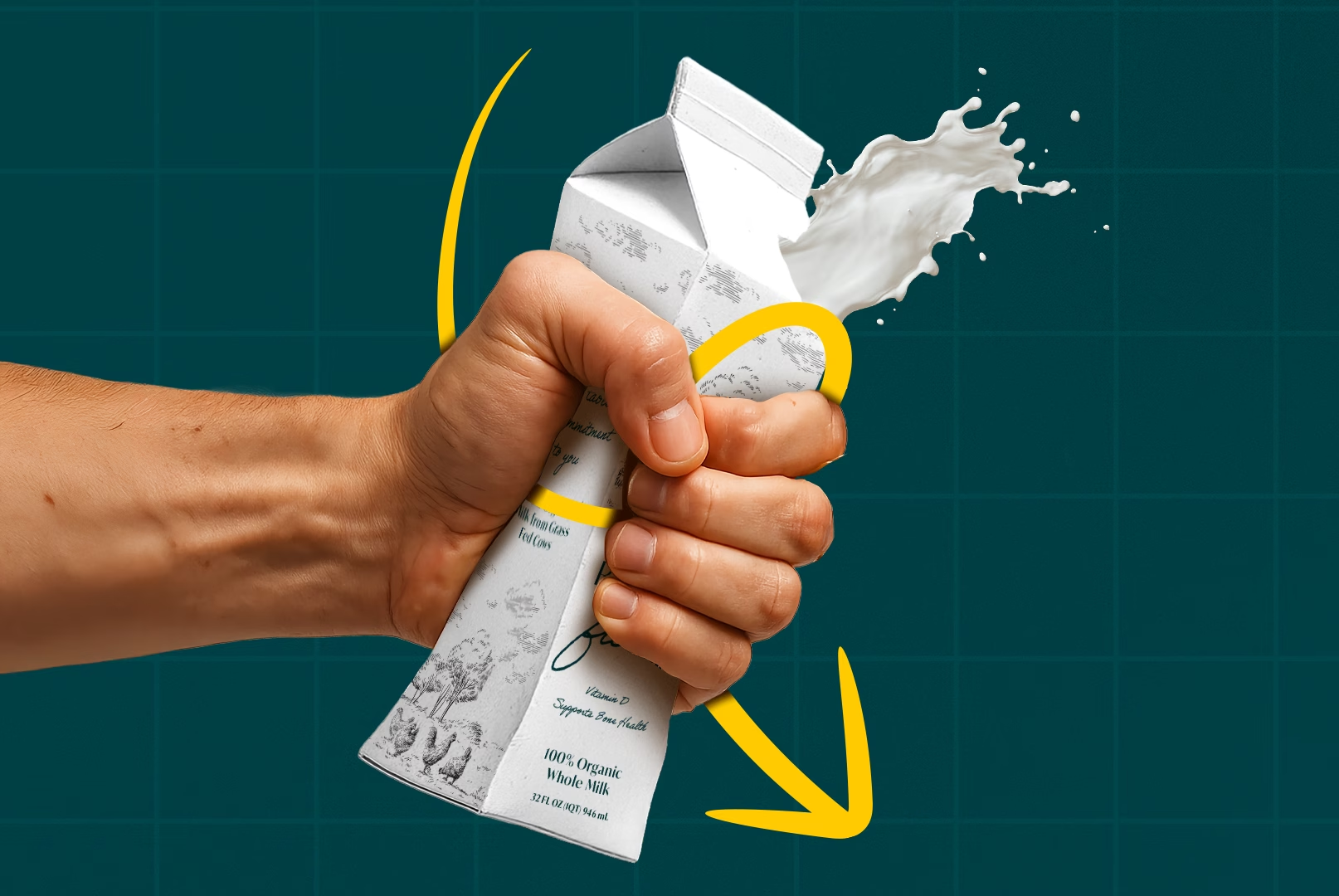
Margin pressure has stopped being a short-term challenge and become a defining feature of today’s grocery CPG industry — and the leaders outperforming are those turning that pressure into performance.
Though overall inflation has eased, food and drink prices remain around 4.5% higher year-on-year, keeping shoppers focused on value and forcing brands and retailers to work harder for every sale. Promotions now account for nearly a third of grocery spend—the highest level in four years— while private label continues to expand its value share and discounters extend their reach.
The brands that are pulling ahead aren’t those avoiding pressure—they’re the ones using it to tighten execution, improve visibility, and build margin discipline into the everyday. For grocery CPGs, where availability and service define competitiveness, margin control now demands faster, more responsive management—not quarterly retrospection.
“As inflation slows, a paradox is emerging for consumer companies. While on one hand, prices have risen too much to maintain consumer spending, on the other, they haven’t risen enough to keep up with increasing costs and mounting pressures from retailers. … For top CPGs, the average EBIT margin remains near a 10-year low.”
Bain & Company
Four disciplines now define how the best CPGs protect and grow margin.
1. Make promotions earn their keep
The most effective CPGs treat promotions as strategic investments, not discounts. Every pound deployed should work as hard as any other investment—creating incremental value, not simply shifting volume.
Each promotion must have a defined purpose: to defend a key value item, recruit new shoppers, or trade consumers up within the portfolio. The question is no longer “Did we sell more?” but “Did we grow profitably?” Teams that can track performance at the right level of detail can quickly identify which mechanics genuinely drive incremental value — and which simply subsidise sales.
Retailers expect the same discipline—proof that every event grows the category, not just the brand. Increasingly, leading CPGs are moving toward weekly promotional ROI reviews, actively trimming under-performing events and reallocating investment toward mechanics that drive both rate of sale and margin.
2. Signal affordability through smarter pack architecture
Value perception now defines category growth. With shoppers anchoring on price and private label setting new benchmarks for value, margin protection depends on how clearly brands signal affordability—without diluting equity.
Leaders are refining price-pack architecture (PPA) to make that signal visible everywhere. Entry formats stay on shelf alongside core and premium lines, ensuring shoppers see accessible price points within the same brand block. A coherent ladder—from small affordable packs to family formats and premium or functionality-led variants—keeps consumers inside the franchise, whatever their budget.
Nestlé, Coca-Cola and P&G each demonstrate how thoughtful pack and portfolio design can sustain performance as consumer spending splits between value and premium. Nestlé’s portfolio reflects what it calls a “bifurcated market”: accessible Nescafé lines for value seekers alongside Nespresso ranges for quality buyers. Coca-Cola’s expansion of mini-can formats reinforces affordability without discounting, while P&G’s “superiority plus value” strategy applies the same logic—protecting price perception and profitability even as demand polarises.
Brands that regularly review performance across pack sizes and channels can see which formats strengthen rate of sale and value perception, keeping both shoppers and margins within the brand.
3. Simplify the portfolio
Complexity remains one of the most persistent drains on profit. Leaders are pruning tail SKUs, streamlining materials and simplifying structures to refocus on what drives value. Unilever, for example, has launched a global productivity drive aiming for €800 million in cumulative savings; it is already ahead of plan and expects around €650 million of that by end 2025. Similar rationalisation drives across food and household portfolios are freeing capital and improving efficiency.
Low-velocity SKUs consume planning time, materials, and changeovers that add cost without growth. Trimming them lowers COGS, simplifies supply chains, and improves on-shelf availability for lines that sell. This isn’t ruthless deletion but intelligent simplification: keep products that recruit new buyers, expand baskets, or enable premium trade-up; retire those that fragment demand.
By understanding where duplication, low rotation, or poor availability erode profit, brands can simplify intelligently — focusing resources on the products that truly earn their place on shelf.
4. Build a responsive operating rhythm
Margin performance is increasingly shaped by how quickly insight is turned into action. Quarterly reviews still catch the trend; daily signals and weekly cycles keep the system aligned. Traditional S&OP provides the long view, but many leading CPGs are now adding a short-term S&OE layer—a focused rhythm that monitors what changed this week and what must adjust next.
“One global food and beverage company recently adopted an AI agent platform primarily to address retailer support and operational efficiency. The agents help manage workflows, prepare customer meeting briefs, and consolidate key commercial data—like inventory, orders, and promotions—across systems. This reduces the time spent on manual coordination, improves speed to insight, and enables the company’s support teams to focus on higher-impact activities.”
Mckinsey & Company
High-performing teams now conduct weekly cross-functional reviews based on near-real-time sell-out and stock signals, providing a sharper view of what’s happening in-store and at the depot. This enables them to surface only the exceptions: SKUs drifting off forecast, events missing their ROI targets, or availability gaps on key value items.
This rhythm gives leaders command of the near term without losing sight of the plan. It turns visibility into action, connecting what happens on the shelf to decisions made in head office. The result is a margin system that moves as fast as the market it serves—responsive, coordinated, and built for continuous performance.
Making margin a system, not a squeeze
The best-performing CPGs no longer chase margin—they engineer it. They build systems that anticipate disruption, course-correct weekly, and link every commercial decision back to profitable growth. Promotions, packs, portfolios, and planning aren’t separate disciplines; they form a single operating system that sustains performance through volatility. When every lever works together, margin stops being a constraint and becomes a capability.
Sources
- Financial Times, “UK inflation unexpectedly holds steady at 3.8% in September 2025.” https://www.ft.com/content/aa0e8c7c-848c-40cc-a818-efd3ad40fffd
- Kantar, “All eyes on price as promotions ramp up.” (Mar 2025, UK) https://www.kantar.com/uki/Inspiration/FMCG/2025-wp-All-eyes-on-price-as-promotions-ramp-up
- Unilever press release, “Resilient performance, full year outlook reconfirmed.” https://www.unilever.com/news/press-and-media/press-releases/2025/resilient-performance-full-year-outlook-reconfirmed/
- Food Dive, “Coca-Cola to roll out single-serve minis in c-stores.” https://www.fooddive.com/news/coca-cola-single-serve-mini-cans/802472/
- Consumer Goods Technology, “Consumer Behavior Snapshot….” https://consumergoods.com/pg-pepsico-nestle-kimberly-clark-consumer-behavior-snapshot-bifurcated-market

