Stocking up for Christmas
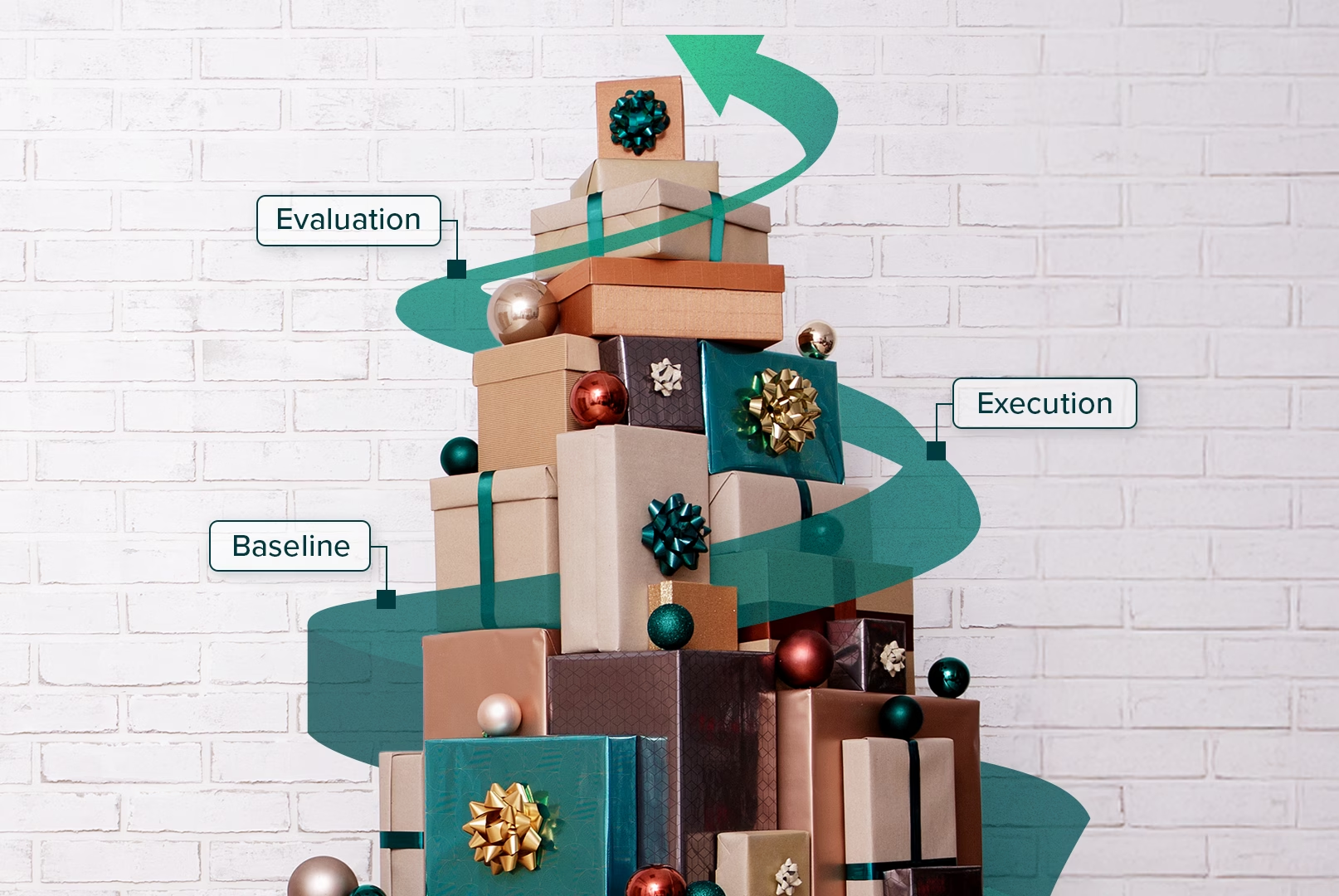
Christmas: it’s the most wonderful time of the year, so they say. But for grocery retailers and their suppliers, it’s also the most demanding. Months of planning come down to a few crucial weeks where every decision matters—every order, every delivery, every shelf filled just in time.
For commercial teams, supply planners, and field colleagues, the season is about precision under pressure.
Despite the preparation, the season continues to defy easy prediction. Christmas 2024 saw record-breaking grocery spend of £13.8 billion in the four weeks to 29 December. Yet that +3.4% value growth was entirely driven by grocery price inflation of 3.7%, with volumes flat year on year. It’s a reminder that the opportunity may be huge—but it is far from guaranteed.
Growth today isn’t just about keeping shelves full; it’s about understanding what drives every sale. Shopper behaviour has become more complex, shaped by loyalty pricing, early promotions, and premium own-label growth. Each of these forces changes how demand forms, where it peaks, and how it fades.
For suppliers, the challenge is to stay agile through all of it—forecasting with cleaner data, executing with sharper visibility, and learning fast enough to improve the next cycle. Success now depends on mastering the whole process, from the first plan to the final review, turning Christmas from a single event into a year-long discipline.
Year | Total Dec Sales (Value) | YoY Value Growth | YoY Volume Growth | Grocery price inflation | Market Dynamic |
2024 | £13.8 billion | +3.4% | 0.0% | 3.7% | Record value sales driven by inflation; volumes stagnate. |
2023 | £13.7 billion | +7.0% | +2.0% | 6.7% | Return to volume-led growth amid moderating inflation. |
2022 | £12.8 billion | +9.4% | -1.0% | 14.4% | Record value growth driven entirely by peak inflation; volumes decline. |
2021 | £11.7 billion | -0.2% | Not specified | 3.5% | Post-pandemic stability; sales elevated vs 2019. |
Table 1: UK Christmas grocery market performance (Source: Kantar)
Rethinking forecasts beyond last year
Last year’s sales line rarely tells the full story. A headline growth figure can mask the forces at work beneath it—price inflation inflating value sales, hidden losses from stock-outs reducing recorded volumes, and the weight of promotions pulling demand forward or pushing it between products. Unless those effects are disentangled, last year’s figures mix multiple influences into one line. It’s not a true view of shopper demand—and using it as the basis for this year’s forecast risks repeating those same distortions.
The task is further complicated by how retailer strategy has evolved. Promotional calendars, once predictable, are now shaped by loyalty mechanics and data-driven segmentation. For 2025, forecasts must account not only for what sold but how it was sold. Two structural shifts stand out.
1. The rise of loyalty-driven pricing
In just a few years, Christmas promotions have shifted from broad-based deals to targeted, member-only pricing. During the 2024 festive period, 27% of all FMCG sales were on promotion, the highest level in three years. The major supermarkets led this shift. Kantar reported that 44% of Tesco’s spend was on deals, while promotional participation at Sainsbury’s and Tesco reached 34–35%, much of it linked to loyalty-app savings. Sainsbury’s credited its Nectar Prices scheme, in its first full Christmas in 2023, with “powering” its 8.6% grocery uplift.
These programmes are now central to the trading model. Promotional investment increasingly flows through retailer loyalty ecosystems, linking brand funding to member engagement rather than headline shelf price. For suppliers, that means promotional budgets must be planned in line with retailer mechanics—designing funding, depth, and timing so impact can be measured and repeated. As a result, last year’s sales data reflects these frameworks as much as shopper demand. Forecasting needs to adjust for those effects, separating baseline sales from campaign-driven uplift to build plans grounded in genuine behaviour, not inherited conditions.
2. The shopper’s “High–Low” strategy
A pattern that has come to define recent festive periods. While many households continue to trade down to discounters for everyday staples, they also trade up to protect the main Christmas event as a “permissible indulgence.” The behaviour isn’t new, but it has accelerated. After rising 11.9% in 2023, premium own-label ranges grew a further 14.6% at Christmas 2024, reaching a record 7% of total grocery sales—well ahead of branded growth at 4.2% over the same period.
This shift reflects the shopper’s search for affordable luxury—a way to elevate at-home celebrations without overspending. For mid-tier brands, it heightens the risk of being squeezed between value and premium tiers.
Availability now carries greater commercial weight. When branded premium lines fall short on shelf, the shopper rarely waits—they switch. Increasingly, that switch is to the retailer’s own premium tier, giving them both the sale and the margin uplift. For brands, the cost of a missed product isn’t only a lost unit; it’s a lost occasion. That makes execution, visibility, and speed of response as critical to protecting value as pricing or promotion.
Making the most of the sales opportunity
A clean forecast is the blueprint—but execution brings it to life. With the main sales drivers understood, success depends on turning plans into movement: the right stock, the right place, the right time, while balancing availability and waste.
Christmas trading is no longer confined to December. What began with Black Friday has become a two-month season. Households now bring spend forward into November to spread costs across pay periods. You see it in the race for delivery slots and early “main-event” purchases: by mid-October 2024, around 70% of Waitrose’s Christmas slots were already booked, while Sainsbury’s and Tesco opened theirs in mid-October and early November. Retailers also reported stronger early sales of frozen turkeys, with Tesco noting volumes were “up quite significantly” year on year. Miss that first wave and sales are lost before the peak begins.
The final fortnight remains the most demanding—but it’s uneven. Demand concentrates into one or two exceptional peak days (on 23 December 2024, sales were roughly 30% higher than any other day of the year), while adjacent days can be softer because the big shop moved earlier. In 2023, the final week still accounted for about a third of the month’s sales. Stores fill quickly, depots run near capacity, and delivery cut-offs tighten. In that narrow window, a supplier’s choices—where to allocate last-mile stock, which depots to top up, what to hold back—directly shape performance.
Operationally, the levers are immediate: monitor sell-through daily, rebalance between depots, prioritise high-velocity SKUs and regions, and taper replenishment as soon as the peak rolls through. The same visibility that powers the peak also governs the slowdown: after households front-load purchases in November and early December, volumes often ease in the final pre-Christmas stretch, then reset in January as everyday baskets return. Managing that transition—neither flooding depots nor running dry—is what turns strong execution into sustainable performance.
Managing the post-Christmas hangover
January doesn’t bring a collapse in demand; it brings a reset. Grocery volumes rose by around five per cent in the first month of 2025 as shoppers returned to routine baskets after the concentrated Christmas shop. The overall market steadied quickly—but not every category did.
Beneath the record headline numbers, December’s growth was driven more by price than by additional volume. Flat unit sales meant many festive ranges faced narrower sell-through windows heading into January. When shopper missions shifted toward fresh food, value, and lower-alcohol choices, seasonal categories—desserts, confectionery, and premium drinks—slowed sharply. Kantar reports that January spending on fruit, vegetables, and salad was £193 million higher than in December, while low- and no-alcohol ranges also gained share. The issue wasn’t falling demand, but misalignment: stock built for celebration meeting demand shaped by restraint.
For commercial teams, this transition defines the real post-Christmas challenge. Margins come under pressure as festive lines are cleared through markdowns or write-offs, tying up cash and capacity that should already be rotating back to core ranges. The solution lies in narrowing that gap—tapering production earlier, tracking depot stocks daily, and aligning replenishment with actual sell-through.
Wrapping up
Christmas will always be the grocery industry’s most defining test—but the nature of that test keeps evolving. As 2025 approaches, the pressures of fragile consumer confidence, loyalty-driven pricing, and the “High–Low” shopper are not just challenges; they are data points.
Together, they have made last year’s sales figures an unreliable guide, blending true demand with the noise of inflation, promotions, and stock-outs. The challenge for suppliers is no longer prediction—it’s precision.
Success now lies in building a repeatable operating rhythm. It begins with separating forecasts from historical noise and ends with a disciplined exit strategy, powered by real-time visibility. It demands that suppliers manage both the fast-approaching peak and the sharp January reset with equal skill.
The winners will be those who stop treating Christmas as a one-off scramble and start managing it as a continuous cycle: forecast, execute, adjust, learn.
Sources
- Kantar, Grocery Market Share UK (Jan 2025).
- Kantar, Grocery Price Inflation Tracker (Dec 2024).
- NIQ, State of the Nation: Christmas Trading 2024 (Jan 2025).
- The Grocer, “Tesco leads loyalty-linked promotions” (Jan 2025).
- Sainsbury’s Q3 Trading Statement (Jan 2024).
- Kantar, Christmas Grocery Review 2024 (Jan 2025).
- Waitrose Press Release (Oct 2024).
- The Grocer, “Christmas delivery slot race begins” (Oct 2024).
- Tesco Christmas Trading Statement (Jan 2025).
- NIQ, Christmas 2024 Trading Report (Jan 2025).
- NIQ, State of the Nation – Christmas 2023 Review (Jan 2024).
- ONS, Retail Sales Index (Jan 2025).
- Kantar, Grocery Category Insight (Feb 2025).
- WRAP, Quantification of Food Surplus (2023).

