
AI is no longer a distant goal for CPGs. It is already changing how the industry plans, sells, and delivers.
Over 70% of consumer-goods companies now use AI in at least one commercial area [1], and those with higher digital maturity are seeing up to 15 percentage points more in total shareholder returns [2] than their peers. The benefits are clear: faster responses, leaner inventories, and stronger margins [3].
However, the opportunity also brings challenges. Forecasting, promotion optimisation, and supply-planning systems have long been part of commercial operations — now increasingly enhanced by AI. Yet because these systems often draw on different datasets or definitions, the intelligence they produce remains fragmented. Each works well within its own scope, but without a shared data foundation, insights can conflict, lose precision, or arrive too late to influence decisions. Real impact comes from a unified view of demand, where AI-enhanced systems use the same data and decisions across planning, supply, and execution move in step.
The shift to AI-enabled commercial performance
From | To | Commercial impact |
Fragmented demand signals from EPOS, shipments, and depot stock, reconciled manually after the fact | AI-ready Flow-of-Goods data harmonised across all retail accounts and accessible to every team | Shared, accurate demand visibility; faster, coordinated action across sales, supply, and finance |
Static, backward-looking forecasts refreshed monthly | Machine-learning driven forecasting that learns continuously from live data | +10–15% forecast accuracy, up to 40% fewer shortages [4] |
Portfolio reviews based on static KPIs (Rate of Sale, margin, share) | AI-enabled range optimisation that identifies incremental SKUs and trims unproductive complexity | 5–10% improvement in shelf productivity [2,5]; stronger category rationale with retailers |
Reactive issue management — detecting depot or store problems after lost sales | Proactive anomaly detection and AI-driven alerts within hours | 30–50% productivity uplift [7]; earlier recovery of sales and improved service levels |
Disconnected planning and execution tools | Unified AI ecosystem spanning planning, execution, and review | 89 % of CPGs are actively using or evaluating AI, 87 % report revenue gains and 94 % cost reductions [8] |
Manual ROI analysis based on lagging metrics | AI-based performance attribution linking actions to outcomes | 7–13 pp EBITDA gain through smarter resource allocation [6] |
Human-dependent monitoring of promotions and events | AI agents automating detection, prioritisation, and response | 84 % of CPGs have AI projects aimed at growth; 86 % of top performers prioritise revenue growth over cost cutting [9] |
Isolated teams working from siloed data | Cross-functional collaboration on shared, AI-ready data | Higher retailer confidence and reduced internal friction |
This is why commercial leaders are rethinking what it means to be “AI-enabled.” The next big advantage comes from connecting these tools into one process that covers planning, execution, and review. When intelligence is present at every step, from depot to shelf, decisions become faster, more accurate, and more profitable.
This article explains how this connection works in practice. It shows how CPGs use AI to build live forecasts, keep portfolios optimised, close the gap between signals and shelves, and prove ROI. It also looks at what’s next: AI agents that work within this connected system, turning insights into action quickly and at scale.
A good plan starts with a solid forecast. If your baseline is unclear, every action feels uncertain. AI now helps you learn from the entire flow of goods and build forecasts that keep up with the market.
A forecasting model that learns
To make confident decisions, you need a solid demand baseline. Still, many CPG teams deal with scattered data in different formats and at different times, making it hard to align. This leads to guesswork about what is actually happening.
Modern demand intelligence platforms help solve these problems. Automation now brings together daily retailer and supply data, cleans and organises it, and links product codes and categories across accounts. This creates the solid foundation needed for accurate, comparable analysis.
AI adds another important layer of intelligence to this foundation. In demand intelligence, algorithms constantly analyse sales, stock, and shipment data to separate the factors that affect demand, such as promotions, seasonality, and distribution changes. This helps reveal the real demand behind performance and creates baseline forecasts that adjust as conditions change.
The result is a reliable, live demand signal that strips out the noise, helping commercial teams plan ahead, act sooner, and focus resources where they matter most. McKinsey’s benchmarks show that AI-enabled forecasting improves accuracy by 10–15% and cuts shortages by up to 40% [4].
Once you trust your forecasts, the next step is to focus. You need to know which products matter most. AI helps you see which products drive growth and which ones hold you back.
Using connected insight to shape the portfolio
A clear, connected forecast is the foundation, but strategy lies in the portfolio. Today, diverse shopper preferences and years of range expansion have stretched portfolios thin; more than 75% of UK CPG executives are reportedly considering SKU reductions [5]. The risk is cutting the wrong ones — removing profitable lines or limiting shopper choice.
The real challenge for leaders is separating complexity that drives growth from complexity that erodes value. Traditional range reviews, using familiar metrics like Rate of Sale, gross margin, and category share, often miss local nuance and treat all outlets the same, hiding products that are essential in one place but average elsewhere.
This is where AI provides a new layer of commercial control. Building on the reliable demand baseline, AI moves beyond these traditional metrics to find patterns people miss:
- It can see true demand, distinguishing sales limited by supply gaps from genuine low shopper demand.
- It identifies nuance, grouping stores with similar trading profiles to show where SKUs excel or, conversely, where distribution adds little extra volume.
- It links profit to performance, automatically spotting which SKUs rely on deep promotions to keep share, versus those with a strong, profitable base.
This intelligence also drives efficiency. By connecting performance to waste, stockholding, and availability signals, AI finds SKUs that regularly lose profit due to poor execution or persistent supply issues.
This is key for forward planning. AI-powered scenario testing lets teams try out range changes before they happen, while predictive analytics track each SKU’s progress and highlight early signs of flatlining or growth.
Even the best plans can fail if you don’t act quickly. AI is most useful when it helps you spot and fix problems and their knock-on impacts before they reach the shelf.
Closing the signal-to-shelf gap
A strong forecast and an optimised portfolio are essential, but daily changes like depot delays, phantom stock, delivery errors, or sudden demand surges can quickly disrupt supply and reduce retailer trust. The real test is how quickly teams can spot, understand, and fix changes before they affect availability or cause waste.
Traditional reporting only shows problems after the damage is done. By the time weekly summaries reveal missed deliveries, stock build-up, or shelf gaps, it’s already too late. Teams end up explaining lost sales instead of preventing them.
AI changes this. By analysing demand signals in near real-time, it learns what is normal for each SKU, store, and region, and flags when performance starts to change. More importantly, it can predict where disruptions might happen by looking at patterns in service levels, depot stock, and past volatility, highlighting risks before they reach the shelf.
When an anomaly appears, AI pinpoints the cause and weighs its impact. It can distinguish between demand surges, supply shortfalls, and execution errors, guiding teams to the interventions that will protect the most sales and key accounts.
During important times like promotions or NPD trials, this quick response is even more valuable. By tracking the flow from forecast to shelf sell-through, AI spots early warning signs such as uneven distribution, depot congestion, or sudden demand spikes. This helps teams adjust quickly and keep availability on track.
Better foresight and quicker reactions lead to more accountability. AI now connects cause and effect. It shows where every pound spent, every range change, and every store action adds value.
Proving ROI on every pound spent
This new level of operational accountability allows for the final, critical step: proving the ROI of every pound spent.
In today’s inflationary environment, recovering volume requires organisations to invest resources wisely and focus on clear ROI. Yet many still struggle to identify which activities truly deliver value, making targeted investment more important than ever.
The real challenge is getting true clarity. Traditional reporting often involves tracking metrics separately, which hides accountability. AI brings signals together and compares them to a real-time baseline, showing what actually grows sales so investment goes to proven returns.
AI’s strength is in attribution and foresight. It can look at many factors at once — showing how promotions, price changes, or distribution moves interact — and forecast their likely returns before they happen. This predictive view lets commercial teams plan events with confidence, knowing where investment will have the biggest impact.
Each campaign also becomes a chance to learn. AI feeds results back into future planning, improving forecasts and investment models over time. This creates a closed loop of commercial intelligence, where every decision makes the next one better.
McKinsey estimates that AI-driven revenue management can add 7 to 13 percentage points to EBITDA margin [6] for large consumer businesses, primarily through more efficient resource allocation.
The real advantage is not just the technology, but how leaders use it. AI is becoming part of daily commercial routines, helping growth based on coordinated action.
Agents of change
AI agents are already changing how commercial teams work. While demand intelligence provides the visibility and foresight to plan effectively, agents take the next step by turning that intelligence into coordinated action.
They monitor live signals across sales, stock, and promotion performance, surfacing risks earlier and recommending actions that protect sales and profit.
This marks a step beyond traditional decision support. AI agents bring automation into the flow of commercial work — highlighting anomalies, prompting adjustments, and tracking the results to improve the next response. Precision becomes continuous, self-improving, and directly tied to measurable impact.
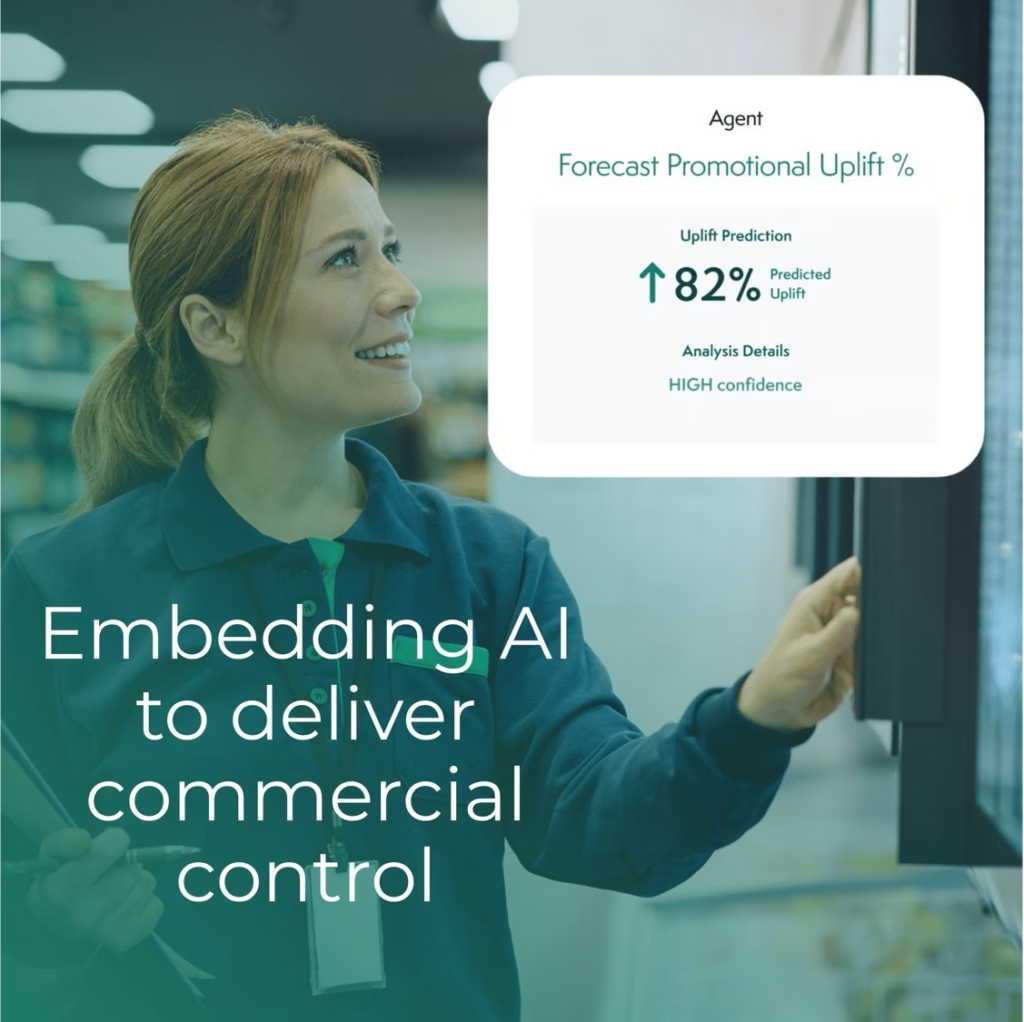
AI agents are already shaping commercial performance. The Promote Uplift Agent now helps CPGs act on promotional opportunities at scale, turning insight into measurable action. And this is just the start. Built on the same live data foundation, future agents will extend across the full spectrum of commercial activity — from forecasting and planning to execution — strengthening control at every stage of decision-making.
The new commercial advantage
Leading CPGs are moving beyond adoption to true integration by embedding AI into the commercial rhythm of forecasting, portfolio management, and execution.
This isn’t about replacing commercial acumen or instinct; it’s about reinforcing it with real-time evidence. AI’s strength is learning from connected data, identifying risks before they impact sales, and validating results with precision. By giving sales, supply, and finance teams a single, live version of the truth, it turns complexity into coordinated action.
For commercial leaders, this shift is structural. As price-led growth fades competitive advantage will hinge on speed, precision, and foresight—capabilities that connected AI now makes scalable and repeatable. The next era has arrived: AI agents transform intelligence into action at machine speed, delivering commercial control that is consistent, self-optimising, and decisively proactive.
Sources
1. McKinsey & Company (2023). State of AI in Consumer Packaged Goods 2023.
2. Bain & Company (2024). Winning with Digital in Consumer Products.
3. McKinsey & Company (2024). How AI Is Reshaping Commercial Excellence in CPG.
4. McKinsey & Company (2024). AI Demand Forecasting Benchmarks.
5. dunnhumby (2024). Retail Trends and Category Insights 2024: UK Grocery Outlook.
6. McKinsey & Company (2023). AI-Enabled Revenue Management: Capturing Margin Through Better Decisions.
7. Boston Consulting Group (2023) AI and Data in Consumer Industries: Embedding Intelligence in Everyday Work.
8. NVIDIA (2024) State of AI in Retail & CPG Report.
9. Tata Consultancy Services (2024) AI for Business Study — CPG Sector Findings.
10. Keynote at the British Food Manufacturing & Ingredients Summit, March 2025; as reported in Food Manufacture magazine