
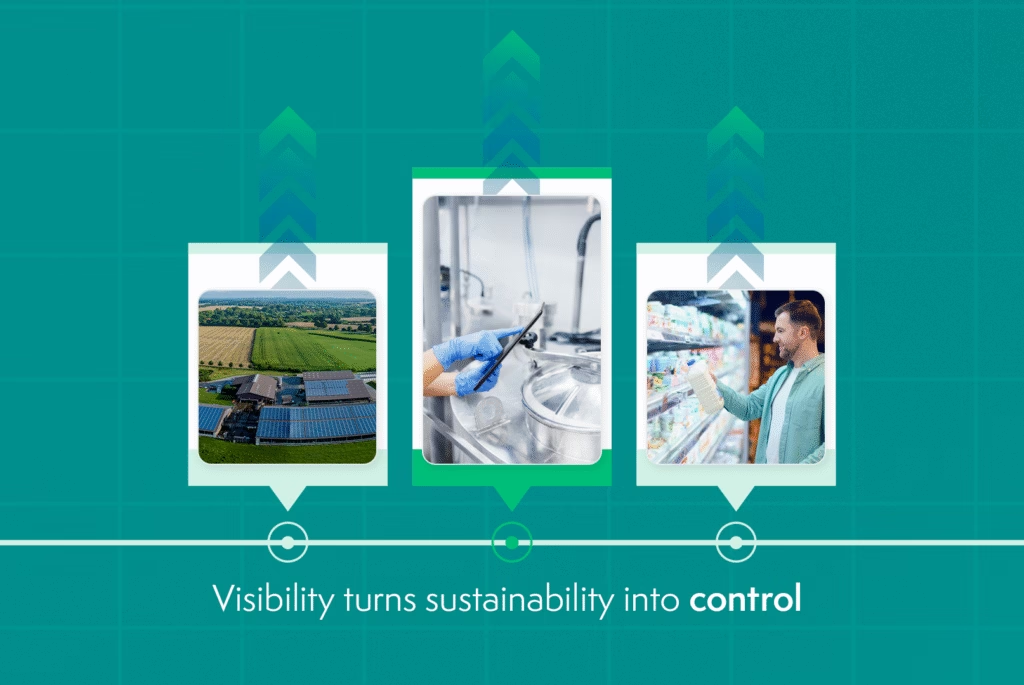
How operational visibility is transforming cost control and carbon performance across the dairy sector.
Dairy margins are tight — often just two or three percent — leaving little room for inefficiency. Every litre counts. Waste, rework, and unnecessary miles drain both profit and resources. Remove them, and you improve both the P&L and the footprint in the same move.
That connection is no longer theoretical. Across the supply chain, teams are updating intake, scheduling, and routing daily against daily demand signals rather than weekly averages. The result: fewer diversions into lower-value uses, fewer empty or overstocked shelves, and a measurable drop in energy use and emissions. Efficiency and environmental performance now advance in parallel.
From efficiency to value
Profit follows when you can see loss precisely. When high-waste stores are acted on before disposals build, when post-promotion overhang is managed by mechanic and region, and when ghost stock is caught early, avoidable cost disappears — and availability strengthens.
Make that same operational clarity routine upstream and value stays in the system. Align intake and throughput to real-time pull, and channel any surplus into longer-life formats rather than write-offs. The payoff is clear: fewer emergency runs, fewer wasted miles, and less energy-intensive rework. Visibility, not scale, now defines control.
For many producers, this marks a shift in culture as much as process. Decisions that were once reviewed monthly are now made daily. Data that once lived in reports is visible across teams, guiding production, routing, and packaging trials in near real time. The ability to see — and act — faster is becoming the most powerful lever of both performance and sustainability.


When packaging meets performance
In packaging, commercial and environmental goals have converged. The real question isn’t whether a new format is recyclable, but whether it maintains sales velocity, smooth replenishment, and reduced material waste. Success depends on testing, measuring, and scaling — and adapting quickly when data signals risk.
With Extended Producer Responsibility (EPR) costs phasing in from 2025, poor formats now hit both the cost line and the waste line. The best producers treat packaging as a live test-and-learn process, tracking each format’s sell-through, waste, and replenishment cost. Formats that deliver on all three scale fast; those that don’t are rolled back before damage is done. Buyers see reduced risk on shelf — and tangible progress on plastics and recyclability.
The same thinking now applies beyond the pack. Pallet configuration, case size, and film thickness are being modelled not just for recyclability but for storage and transport efficiency. A lighter, stackable format that improves vehicle fill by even two percent can eliminate thousands of unnecessary miles a year. Environmental and commercial returns are now measured on the same line.
Visibility as the new margin driver
Every sustainability initiative that delivers measurable improvement does so because it fixes a process already leaking value. Farm-level emissions projects improve yield and cut haulage intensity. Packaging redesigns save on materials and logistics. Network consolidation trims both transport miles and energy use. The pattern is consistent: profitability increasingly follows the same path as carbon reduction when decisions are guided by live data.
Transparency makes that possible. When producers can measure not just what left the depot but what sold, what sat, and what spoiled, they can see the full cost of poor alignment. A product that moves three days late or sits two days too long has already added both waste and carbon. Closing that gap — acting inside the trading week — is where the real return lies.
This level of visibility is also changing how teams collaborate. Operations, sales, and sustainability functions are increasingly working from the same daily figures — sales, stock, waste, and execution. With everyone aligned to a single source of truth, decisions pull in the same direction, and both cost control and carbon performance improve together.
Extending visibility into production
More than 40 percent of dairy emissions arise in milk production and processing. Every litre that fails to reach a buyer at full value — whether downgraded or wasted — adds both carbon and cost. The next step for producers is using demand visibility to shape how and when production runs.
By linking real-time sales data with intake and scheduling, producers can run shorter, steadier campaigns that use less energy, generate less spoilage, and reduce transport intensity. Depots hold less excess, retailers receive the right SKU mix, and category availability stabilises.
Several leading processors are already proving the impact. By connecting daily retail sales with production planning, they’ve reduced waste volumes by double digits while cutting energy use per tonne processed. For some, that has meant re-sequencing production lines to match mid-week demand peaks — small, data-driven adjustments that collectively deliver major gains.
From pledge to profit
The main lesson is that visibility turns sustainability into financial control. Once a business can track its losses in motion sustainability is no longer a story about good intentions; it’s part of everyday cost management.
What separates leaders from followers is no longer the pledge but the proof — the ability to show that lower waste, smarter packaging, and efficient production directly protect profit. The businesses that succeed on both fronts are the ones that treat data not as reporting, but as a way to manage performance. They use it to make sustainability measurable inside the operating day.