

Nick Calver, Marketing Director
When things don’t go according to plan, understanding what is happening, why it’s happening, and how you can intervene to turn the situation around is crucial. Transitioning from a passive report reader to a proactive actor requires well-organised data, intuitive tools, and data-driven analysis.
Commercial teams often hit roadblocks when trying to forecast the impact of their strategies and measure their success. The heart of the problem? It’s tricky to grasp how different sales tactics—such as special deals, pricing adjustments, and product offerings—actually sway shopper demand. Adding to the challenge is the slow pace at which feedback comes in, making it tough to quickly gauge whether these strategies are hitting the mark.
Deciphering deviations from planned performance
Adapting to change with precision hinges on your ability to decode why actual performance strays from the expected. It’s not just about having a thorough plan in place; it’s about deeply understanding what drives those gaps. Sure, you might have intricate plans laid out for your key customers, from sales goals to comprehensive Joint Business Plans. But the real test is in your agility to spot, grasp, and relay these shifts as they happen.
The importance of detailed sales monitoring
Most businesses track their sales performance against set plans, diving into details by category and customer through detailed reports. These insights, frequently drawn from data giants like Nielsen and Circana, offer a bird’s-eye view, revealing trends over extended periods. However, the critical question is: how do you translate this type of reporting into immediate, targeted, high-impact actions?
When sales fall short of targets, the response cannot be generic. Commercial packaged goods (CPG) businesses need to monitor all their products across all their major customers and locations daily if they want to understand where sales are underperforming or exceeding expectations in sufficient detail to act decisively. Such detailed monitoring enables rapid response to changes in shopper demand, addressing issues like service quality, stock-outs, distribution imbalances, NPD launches and, crucially, promotional execution.
Keeping a watchful eye: visualising the problem
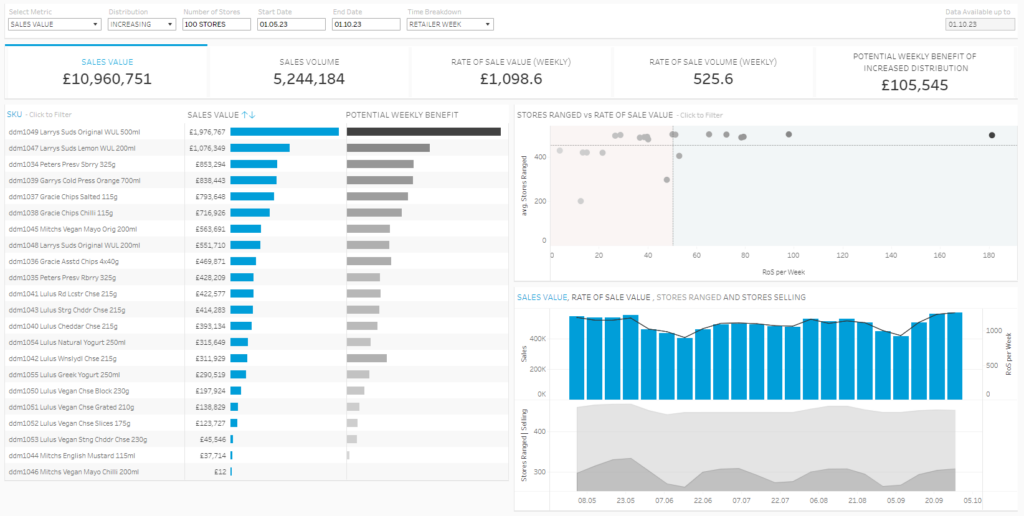
Commercial teams need to access and interpret up-to-date sales performance if they want to make informed decisions. With intuitive visual dashboards, you can not only understand the “what” of recent performance but also the “why” so that you can predict future impact and share insight derived directly from your retail customer’s own data. That means having the ability to:
- Connect sales, service, and stock data and present it on the same page, viewing deviations from your sales plan in context and identifying cause-and-effect patterns.
- Navigate from long-term category and brand trends to individual products in specific locations on particular days, moving rapidly from macro-to-micro perspectives in just a few clicks to identify remedial actions.
- Compare performance over different time periods, exploring trends spanning years and months, down to weeks and days, not limited to pre-formed 4/12/52 week views.
- Examine daily patterns months in arrears; identify repeat patterns such as late stock movements, pre-promotion, or excess waste due to over-distribution. Then, take action to drive the right products to the right locations at the right time.

Don’t be fooled by raw sales figures
Sales figures alone are not a true indicator of demand, as they only reflect what has been sold, rather than the full potential of what could have been sold if shopper demand was entirely met.
Class-leading demand intelligence platforms enable commercial teams to go a step further by providing context beyond initial observations. They harness the power of AI to accurately determine potential demand and pinpoint probable causes of sales deviations, highlighting promotional and seasonal uplifts, and downturns due to availability and cannibalisation. Such enriched intelligence equips CPG teams with insights required to propose effective action, enabling them to defend their market position and meet planned objectives.
Actionable insights to amplify sales
Armed with actionable commercial insights you have the ability to make decisions that deliver planned results by:
- Prompting retail customers for additional orders to avoid stock running low in individual depots and improving availability in stores
- Proposing changes to product distribution, based on hard analysis of detailed customer data
- Preventing excess waste and markdown by ensuring optimal stock levels for planned rates of sale
Want to see SKUtrak in action? Contact us today for a demonstration of how SKUtrak can help with sales driver analysis and performance tracking.