
Insights from Crisp SKUtrak and UpClear’s CPG leadership event with Danone
Revenue Growth Management (RGM) is evolving. What was once a reactive, report-led discipline is rapidly becoming a core driver of commercial strategy. Today, an effective RGM function is powered by daily data, integrated systems, and teams aligned to a single version of the truth.
This shift – and the skills, tools, and collaborative approach that it requires – was the focus of our recent CPG leadership dinner in partnership with UpClear. Bringing together some of the CPG world’s sales, category, and finance leaders, the evening prompted some honest reflections about the evolution of RGM today.
Danone’s analytics-driven RGM journey
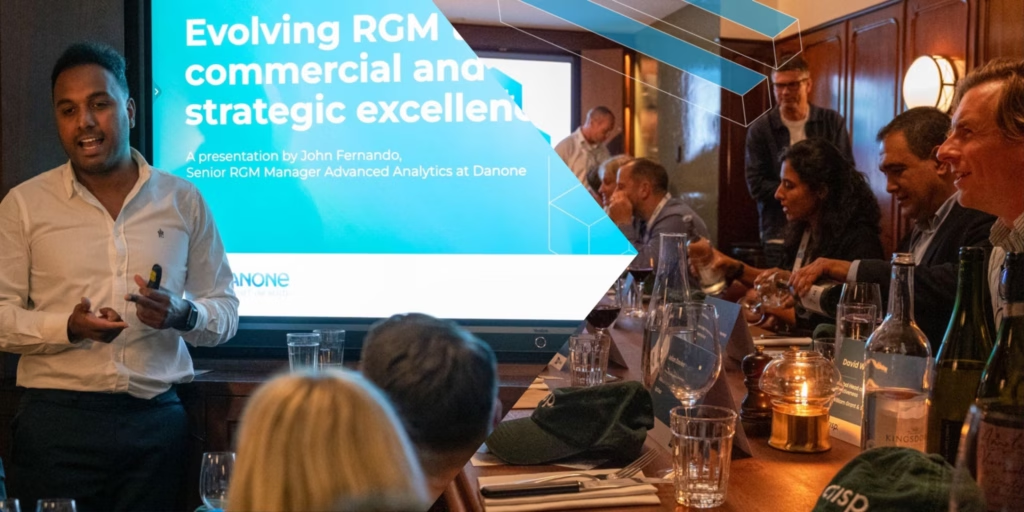
One of the event’s major highlights was a talk from Danone’s Senior RGM Manager, John Fernando. Joining Danone in early 2023, John has since been leading a cross-category push to modernise RGM within the company – no small task in a multinational food company, that spans everything from sparkling water to specialised medical nutrition.
The team previously faced several significant data challenges. This included disconnected and inconsistent data, which lacked the granularity required for robust analysis. A key hurdle was the weekly availability of baseline data, misaligned with promotional periods, making real-time performance evaluation difficult. Furthermore, their reliance on sell-in data, rather than crucial sell-out metrics, led to inaccuracies in assessing promotional ROI, particularly for seasonal product lines. They also lacked critical visibility into factors like product availability, which directly influenced sales during key periods.
John’s vision has remained consistent: transition from using disconnected tools and manual spreadsheet reporting to insight-driven, genuinely scalable operations. “I strongly believe analytics is the engine that fuels the transformation when it comes to strategic excellence,” he noted.
To instil that transformation, John and his team have been focusing on four key pillars:
- Structure
Danone’s first step was the creation of a unified data model. It uses retailer data from Crisp SKUtrak and promotion data from UpClear’s BluePlanner within a harmonised data layer – further enhanced by Crisp SKUtrak TruDemand’s machine learning-based baseline. Establishing a ‘single source of truth’ for decision-making, this unified model gave every team within Danone a consistent baseline from which to work.
- People
“If people don’t come along,” noted John, “the tools won’t work.” For Danone, that meant investing in training and capability development programmes. Regular workshops helped embed the shift from number-crunching to storytelling, he added, empowering the team to establish RGM as a business function that adds value and enables the business to make better decisions.
- Tools
Danone’s move to Power BI and UpClear’s BluePlanner allowed both RGM and commercial teams to answer their own questions in real-time, without needing to prepare static reports. They can now visualise core KPI metrics to support rapid decisions.
- Data
Daily input from Crisp SKUtrak, aligned with strong master data management (MDM), has also helped to create a clean, consistent dataset that supports granular ROI analysis. Crucially, using Crisp SKUtrak’s TruDemand engine has also fixed Danone’s sell out baseline challenges.
This rigorous approach to RGM has enabled Danone to make a significant leap in terms of its RGM maturity. The result: clearer ROI, more accurate KPIs, faster planning, and better decisions across commercial, finance, and category teams alike.

Shared industry challenges, shared ambitions
John’s insight into Danone’s successes clearly struck a chord with our audience, with much of the event’s conversation echoing a few shared themes. Across the table, leaders addressed common hurdles – and shared their own hopes in regard to RGM’s future:
- “Scaling RGM is hard without strong foundations…”
Disconnected, often outdated legacy tools, and under-skilled teams all slow progress. Even the best strategies stall without consistent data and core capabilities to support them. There was strong agreement on the need to first build these core capabilities – reliable data, aligned systems, and upskilled teams – before layering on more advanced analytics and tools as the business matures.
- “Predictive analytics are now essential…”
“We need to move from looking back to looking forward,” as one guest put it. Scenario modelling and forward-looking insight are becoming non-negotiable in commercial planning.
- “Adaptability matters…”
A global dairy brand and a mid-size snacks business require different insights – but the same strategic clarity. Solutions are what you make of them, with principles that flex around a business’ specific circumstances.
- “Integration drives impact…”
Cross-functional tools help insight travel around the organisation – into sales, into finance, and into decisions. When everyone works from the same version of the truth, performance can accelerate dramatically.
The RGM playbook is changing
The event gave us plenty to think about – and some very clear takeaways. From where we sit, the new model for RGM is founded on three imperatives:
- Building RGM into the core of commercial strategy
RGM needs to be at the heart of CPG operations across multiple teams – not just as a reporting function, but as a growth enabler, driving smarter planning, better trade-offs, and shared performance goals across commercial, finance, and category teams.
- RGM capabilities enable proactive decisions to drive better business outcomes
With the right baselines in place, promotions once seen as unprofitable can rapidly show true, incremental ROI while even seemingly successful promotions can be re-evaluated and optimised for greater impact. By moving from analysis to actionable insight it gives teams better, more constructive insights and reduces wasted effort by eliminating ‘incorrect intelligence’ before it can take hold. The result: a more proactive, insight-driven approach to commercial planning that improves business performance across departments.
- Harmonising your tools and data
Consolidated systems and automated reporting provide consistent, decision-ready insights, freeing up teams to act, not just investigate.
More than anything else, it’s important to remember that the changes we’re seeing here are taking us forward. By improving the accuracy of promotional KPIs, we’re enhancing promotional performance and ROI – and doing so at speed. As John so succinctly summarised, “by consolidating our data and automating reporting, we’ve not only saved time but also made it easier for commercial teams to make faster, more informed decisions.”
Let’s keep the conversation going
Thanks to everyone who joined us at this event, and special thanks go to our partners at UpClear. On an RGM journey of your own? We’d love to hear from you. Book a demo today using the form below.