

Ian Hall, COO
Punishing retail suppliers for poor service levels is a lazy approach. We need a new focus on fixing on-shelf availability. As a former Tesco buyer, I often reprimanded suppliers for short deliveries. It didn’t achieve a lot. Buyers read reports indicating missed deliveries, react by making phone calls, and may even threaten fines. This approach is lazy but also misses the point; suppliers want to sell products too.
The shared goal here is to maximise product availability, and that means ensuring that products are on the shelf when shoppers want to buy them. But effective management of your ‘flow-of-goods’ from the production line to the consumer is much more nuanced than simply asking, ‘Did I deliver what my retailer customer ordered last month?’.

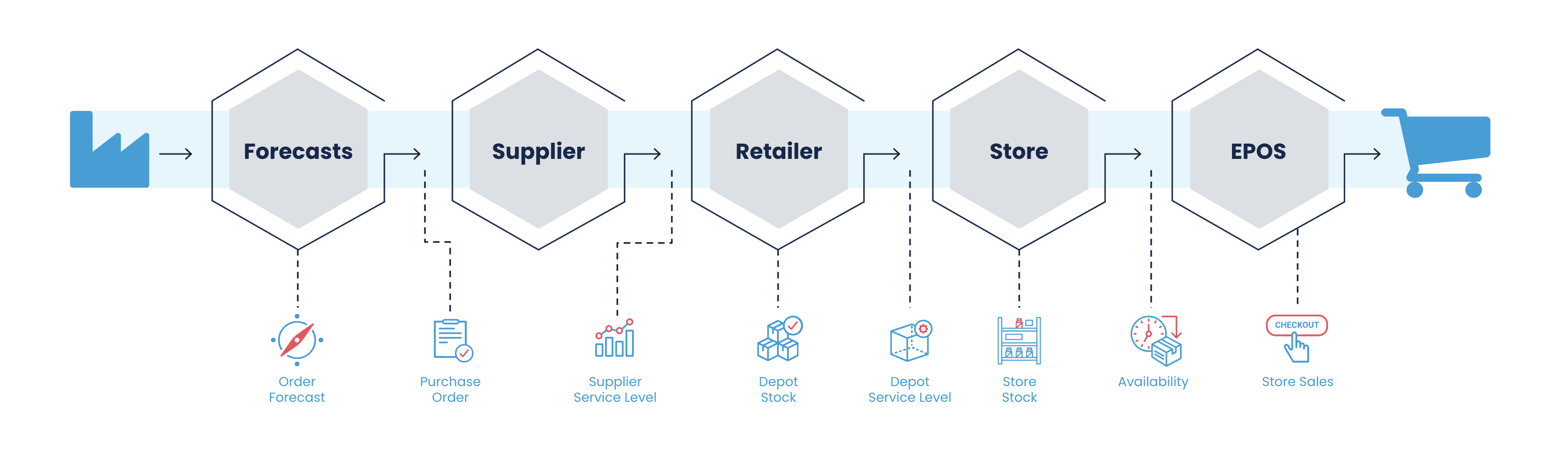
Yet, most suppliers still focus on supplier-to-retailer service level. While it might make for a nice KPI report, it does not fix the problem of gaps on shelves.
Relying on supplier-to-depot metrics does not fix the product availability problem
- It’s rarely the biggest driver of on-shelf availability.
- It assumes that retail customers are ordering optimally: requesting the correct quantity into each depot on the right day.
- It’s not accurate and can be manipulated to look better than it is (if you don’t have stock, you can ask the retailer not to order it – masking the real issues)
- It doesn’t always impact the customer – surely the most crucial measure?
Depot-to-store level is a more helpful measure because it better predicts product availability
The ‘depot to store’ service level is a key metric because it more closely mirrors shelf availability and, as a result, better indicates the potential for lost sales of your products. But, many suppliers overlook this measure or wrongly believe they can’t influence it. I’ve heard some say, “Depot-to-store service is the retailer’s responsibility” – a serious misconception; this assumes that retailers have highly sophisticated, infallible systems that generate perfect forecasts. This is not the case in many instances.
A supplier’s responsibility doesn’t end once stock is delivered to the depot. Assuming that retailers manage all inventory flawlessly, with special consideration of your products, is a huge mistake. In reality, retail supply-chain managers are often tasked with overseeing thousands of products across multiple depots, translating to a daily monitoring task of tens of thousands of items.
Retailers are pragmatic and will focus on major volume lines and promotional items, or address issues with products already out of stock; a reactive approach.
Also, many suppliers still rely on aggregated (e.g., weekly or monthly) reports or averages across many products – “My depot-to-store service level was 98% last month.” While that sounds impressive, it lacks actionable insight. Remember the cautionary tale of the statistician who drowned while crossing a river because “it was 3 feet deep on average”!
The situation is more complex – effective management requires measuring , understanding and acting on demand at an SKU/depot level daily, armed with accurate forecasts of ideal stock levels. This level of detail informs proactive actions and drives improvement.
Why should you focus on demand insights at the SKU/depot level?
- Final step for store availability: It represents the crucial last leg in ensuring availability in stores.
- A link in the chain that can be altered: Suppliers can influence this process more than many think, often understanding demand for individual products better than the retailers.
- Effective prioritisation of deliveries: This approach helps in prioritising deliveries more efficiently, especially important when dealing with limited stock.
How?
- Use sales data as a leading indicator of likely demand from the depot ; stock on hand can be calculated by day for fast-moving items or by week for slower movers
- Monitor stock levels daily instead of weekly; stock cannot be accurately gauged using averages and you cannot act on a weekly basis – interventions generate the most value when taken as soon as issues are detected
- Implement this strategy for all major clients to maximise efficiency; a consistent approach across multiple grocery customers enables an optimal approach to stock allocation, especially when supply is lower than demand
- Enhance your forecasting methods through more detailed analysis; understanding location/item/day demand – at depot and even store – reduces the risk of temporary regional shortages .
- Offer useful insights to your retail supply-chain manager in a clear, concise manner; help them to understand and act quickly (e.g., “We need to order more of this product for that depot, and here’s why”).
Collaborative partnerships, stronger results
Focusing on depot-to-store service levels fosters genuine collaboration, and it helps:
- Suppliers to focus on allocating limited resources effectively
- Retailers to be proactive in managing orders (not just reacting to out of stocks)
- Both parties to sell more by optimising availability
Want to see SKUtrak in action? Contact us now for a SKUtrak demonstration on how SKUtrak can help transform product availability.