

The UK food and drink market is packed with new product launches—but how many are truly capturing consumers’ attention?
According to Mintel, only 26% of food and drink launches in 2024 so far have been genuinely new products (1). Instead, brands are doubling down on line extensions, reformulations prompted by regulations like HFSS, and repackaging—approaches that minimise risk.
Yet playing it safe could be costing brands valuable market share! McKinsey’s analysis reveals that smaller brands and private labels are leading the charge, capturing most of the CPG growth while major brands struggle to keep up (2).
Worse still, just one in three UK product launches achieves incremental growth, a stark indicator that brands need to rethink their approach to stay relevant (3).
Beating the odds of failure
Against a backdrop of inflation, price sensitivity, margin pressure, shift to private label and sustainability concerns, data-driven NPD plays a pivotal role in securing impactful results.
Here’s how:
- Maximising incremental growth: As highlighted by Kantar’s analysis, achieving incremental growth is crucial for successful innovation. A successful product launch should not just transfer shopper spending from one product to another; it should increase expenditure across the category as a whole. By analysing trends and performance patterns, CPGs can identify growth hotspots and uncover under-served areas in the category.
- Balancing premium and value offerings: In an increasingly bifurcated market, balancing premium value and affordability is crucial. Premiumisation offers additional margin beyond simple volume growth, appealing to customers who prioritise experience over cost. With insights from “volume vs value” analysis and consumer spending behaviour, brands can introduce premium products to appeal to brand-loyal shoppers while also capturing the value-conscious segment.
- Developing smarter promotions: Gaining visibility for new products at launch is challenging. Promotional strategies are intended to increase trial rates and maximise the impact of each effort. That’s the theory. The reality? Between 30% and 40% of promotions underperform. This raises a critical question: what drove underperformance: fundamental product-market fit issues or poor promotional planning/ execution? By harnessing data, brands can dissect the factors that contributed to or dampened performance.
- Scaling success across retailers: A strong debut in one retailer is just the beginning. Brands that assess early launch metrics can build a compelling case for broader market reach, using clear performance indicators to pitch expansion to additional retailers. This strategic scaling not only bolsters the brand’s presence but also its position for further growth. When backed by results, these conversations are no longer speculative—they’re rooted in proven shopper demand.
Why demand intelligence is vital
Take the example of Petface, a pet accessories brand that initially used category insights to secure a trial listing of over 400 SKUs in five stores. By leveraging demand intelligence during the trial, Petface demonstrated the value of its range through performance data, which supported its progression to a national rollout. This data-driven approach ultimately led to 80 SKUs being launched across 500+ stores, showcasing how small brands can turn trial success into long-term, sustainable retail partnerships.
Securing retail listings
Winning shelf space is one of the most competitive steps in NPD. Retailers are inundated with new product pitches, so CPGs need to make a strong, data-backed case. Imagine positioning Product X to a retailer with evidence showing its alignment with rising demand, backed by the Rate of Sale (RoS) performance of similar products in key regions. By tying new product variants to proven market demand, brands make a compelling case for placement.

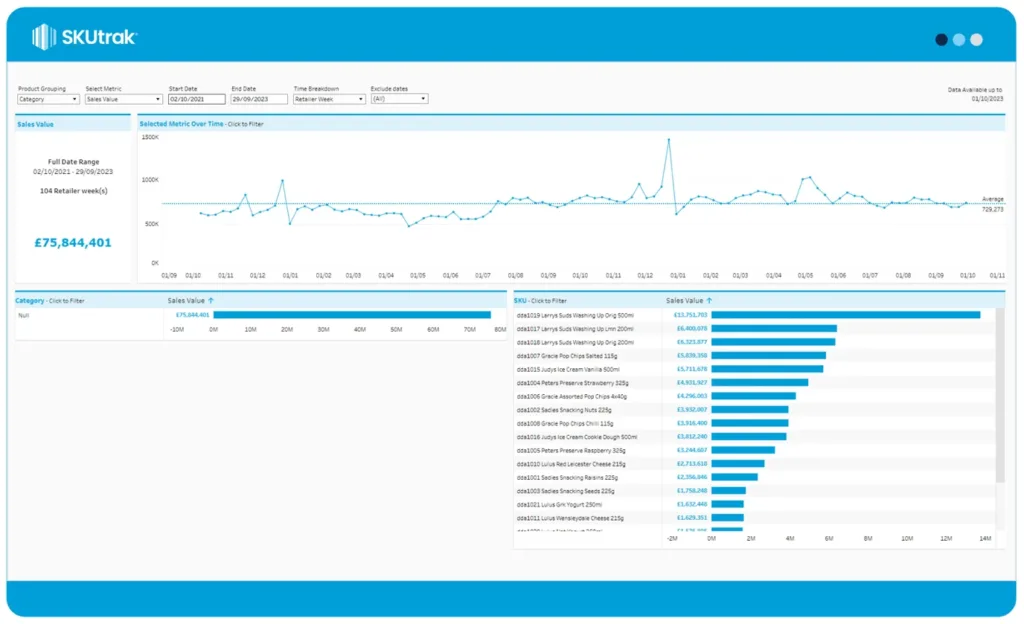
Estate Over Time dashboard
Monitor NPD rollout with precision. The Estate Over Time dashboard enables brands to view sales velocity, distribution trends, and key metrics over time—empowering data-driven decisions for optimised product placement and timely course corrections.
Trial setup and execution
The first weeks after launch are crucial, especially during the typical 12-week trial period. Consistent stock levels and strategic store placement are as essential as the product itself. Even promising products can falter if they encounter supply chain disruptions or end up in low-demand locations. With demand insights, brands can monitor the build-up of stock in preparation for launch, and avoid stockouts, ensuring a successful trial period that meets consumer demand.
Fine-tuning during the trial
Effective trials require continual adjustments. Near real-time performance monitoring of depot stock levels and depot outbound service rates allows brands to quickly identify distribution gaps, avoiding oversaturation in one region while other areas go underserved. Proactively managing these logistical challenges ensures a smooth path to sustained success.
Post-trial evaluation and expansion
The trial phase is just the beginning. As a product moves beyond its initial launch, brands need a holistic evaluation to inform future strategy. This includes analysing regional performance, addressing logistical challenges, and assessing promotional effectiveness and other metrics like availability and waste. These findings allow brands to make a well-supported case for a wider national rollout, demonstrating strong potential for sustained success.
Sustaining success through ongoing optimisation
Once a product gains traction, the focus shifts to maintaining its success. Retailers continuously adjust their shelves based on shopper preferences and sales performance. Brands that continuously track performance can recommend shelf placement tweaks, suggest replacements for slower SKUs, and push for more space for top performers. By continually analysing performance data, brands build a strong case for sustained growth, enhancing retail partnerships.
Conclusion
True innovation doesn’t just add a new product to the shelf; it strengthens the entire category, wins new customers, and justifies retailer confidence. By leveraging data throughout the NPD process, brands can move beyond incremental updates to drive sustainable growth and future-proof their place in the market.
Don’t leave your next product launch to chance—leverage SKUtrak to navigate NPD complexities and set your product on the path to success.
References:
- The Role of Innovation in the Future of the CPG Industry, Mintel, 2024
- What got us here won’t get us there: A new model for the consumer goods industry, McKinsey 2020
- Five factors for successful innovation in UK, Kantar 2020