
Is your product range feeling a bit…lost in the supermarket shuffle? You’re not alone. CPG brands are in a constant battle for prime shelf space, and if your product range isn’t punching above its weight, you’re losing ground (and money!). Don’t let your competitors steal the show.
So what can you do?
This article examines five telltale signs that your product range is limiting your revenue and how to maximise your long-term sales potential.
1. Are you missing out on local opportunities?
Buyers often rely heavily on the “Rate of Sale” (RoS) metric. It seems logical—higher sales per store should suggest strong performance, right? However, this approach can often oversimplify the bigger picture, especially when normalising RoS across different stores. Buyers may overlook localised opportunities by focusing too narrowly on RoS and miss out on potential growth areas, overshadowing your true performance.
Unlocking insights with store-level data
To better understand true product performance, it’s essential to analyse RoS across specific regions, formats, and individual stores. This gives you a comprehensive view of where your products thrive and where they might need a push. Don’t assume that all stores perform equally – they don’t! It’s, therefore, important to flag stores with particularly low RoS for targeted interventions, such as display adjustments, promotions, or better stock management. Sometimes, it may even warrant a candid discussion with your buyer about removing underperforming locations.

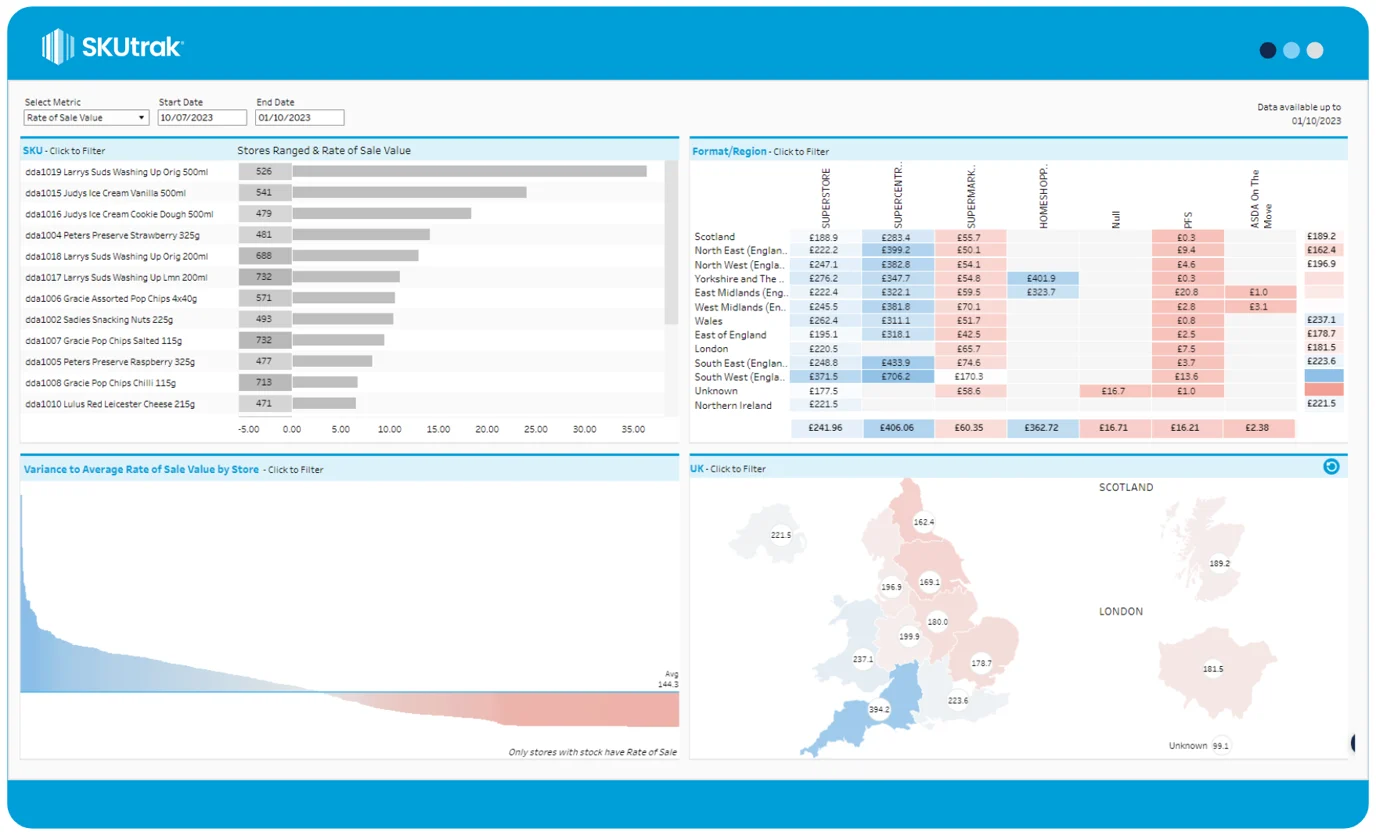
SKUtrak’s Store Rate of Sale dashboard
The Store Rate of Sale dashboard offers detailed insights into sales velocity, showing RoS by SKU across regions, formats, and stores over two years. Use it to identify high RoS but low distribution SKUs and pinpoint stores needing targeted in-store interventions for performance improvement.
Maximising distribution opportunities
Sometimes, your best-performing products aren’t getting the shelf space they deserve. If you have high RoS SKUs that aren’t yet available in all stores, you could be missing out on big sales opportunities.
Digging into your distribution data allows you to spot these gaps and take action. Highlighting products performing well but not fully distributed lets you make smart recommendations during range reviews, ensuring you’re pushing the right products for wider availability.
This proactive approach protects your portfolio from potential delistings, helps you replace underperforming products with better options, and ensures you’re not leaving any local opportunities untapped.
2. Are stockouts misrepresenting your product’s performance?
As a CPG, you might notice that RoS for a key product has dropped unexpectedly. At first glance, this could seem like shopper demand has dropped off. But is that truly the issue? What if there is demand but the product isn’t being replenished fast enough to meet it?
Stockouts are more than just a temporary inconvenience; they create long-term damage. Each time your product is unavailable, you lose sales momentum, miss out on peak demand opportunities, and risk frustrating your retail partners. Worse, frequent stockouts can erode trust with buyers.
The answer is a more proactive approach: combining RoS insights with daily availability tracking. With tools like SKUtrak’s Availability dashboard, you can ensure your RoS reflects actual demand, not just the gaps caused by supply chain issues. This ensures availability problems don’t cloud the true performance of your product, keeping it visible and performing well in range reviews.
3. Are you misjudging the financial impact of availability gaps
As a CPG, you may track availability percentages, but are you also considering the financial impact of those gaps?
Imagine your product shows 90% availability—a figure that can be improved. But what if the missing 10% includes your highest-velocity stores, where product turnover is quickest? The consequences could be far-reaching, leading to significant revenue loss.
SKUtrak’s dashboards provide deeper insights, pinpointing where lost sales and missed opportunities are most critical—whether in terms of volume or, more importantly, value. This enables you to focus on stores where underperformance poses the greatest threat to your sales potential based on each product’s revenue potential.
4. Are depot-level failures sabotaging your in-store success?
Store-level availability is crucial, but as a CPG, you know that depot-level failures can have a knock-on effect, leading to in-store stockouts across multiple locations before you even realise there’s a problem. These bottlenecks can disrupt your distribution network, resulting in lost sales and frustrated buyers.
Monitoring outbound service levels—the percentage of demand fulfilled by depots—provides an early warning system for supply chain disruptions. SKUtrak’s End of Day dashboard offers daily insights, allowing you to pinpoint depot issues and take action before they impact store-level availability.
By addressing supply chain bottlenecks upstream, you are more likely to safeguard your in-store availability, ensure a smooth product flow, maintain service levels, and prevent costly sales disruptions.
5. Is waste eroding profits and buyer confidence?
Waste is also a hidden threat, eroding profits and damaging your credibility with buyers. As a CPG, products with high waste levels become less appealing to buyers, increasing the risk of delisting or reduced distribution in future range reviews.
Many CPGs analyse waste at an aggregated level, which often hides critical fluctuations at the store or product level. Waste might spike during promotions, on specific days, or in stores that overstock without matching demand.
SKUtrak’s Waste dashboard help you pinpoint waste spikes at the store and day level. By addressing these issues—through better stock management or adjusting delivery volumes—you can reduce waste and improve profitability. Demonstrating that you can minimise waste while maintaining strong sales makes your product a more attractive option for continued or expanded distribution.
Conclusion
If any of these signs sound familiar, your product range may be holding back your revenue potential. Don’t wait until your next range review to take action. Over-reliance on high-level metrics like RoS can obscure valuable local opportunities, and ignoring underlying issues like poor availability or waste can lead to misguided range decisions.
Take control of your product range today. Leverage SKUtrak’s powerful dashboards to pinpoint opportunities, optimise availability, and reduce waste—ensuring your products are always positioned for success. Start transforming your range review process now and unlock your full sales potential.
Contact us to book a demo or learn how SKUtrak can support your ongoing range optimisation efforts.